One of the marks of a great song is its ability to stand up to re-interpretation by other artists and in some cases to scale new heights in their hands. Don't shoot me for suggesting that Badfinger's Without You is a mediocre performance of a superb song which only revealed its true beauty when Harry Nilsson made it his own. Pete Ham admitted that Nilsson's rendition of his song was "the way we wanted to do it, but never had the nerve." The Beatles' With A little Help From My Friends suffers, some might say, from Ringo Starr's naive, tonally-challenged vocal, which manages to disguise the quality of the composition. Thank God that Joe Cocker was able to recognise the song's potential and gave the world one of the greatest Beatles covers to date. To call it a cover doesn't perhaps do it justice as Cocker's reinvention of the song launches it into the stratosphere. The fact that such a great song was handed to Ringo to sing on Sergeant Pepper attests to the embarassment of songwriting riches in the Beatles camp.
I seem to recall reading somewhere that Yesterday is the most covered song of all time, with versions ranging from instrumental Tijuana Brass-style interpretations to reworkings by Elvis, Dylan, Sinatra and beyond. In recognition of the wealth of Fab Four covers that exist, today sees the first in an ongoing series of posts featuring unusual, surprising, and downright wonderful re-workings of Beatles songs. It's up to you to decide which category they fall into.
Here's Louisiana band Pot Liquor's interpretation of Lady Madonna. To my ears, their version invests the song with a Little Feat / The Band vibe. There's blues and hard rock influences aplenty on this LP, but there's also a heavy dose of what would now be termed Americana. See what you make of their take on The Beatles classic.
I love the Internet. Without it I would never have tracked down this great little record shop on a recent trip to Cantabria in Northern Spain.
The shop in question, Boikot in Santander, would be a tough one to stumble across without some prior knowledge of its existence as it's hidden away on the first floor of an apartment block, accessible only to those who discover the intercom in the stairwell and get buzzed in by the proprietor, Daniel.
That's not to say that the shop is unwelcoming. On the contrary, Daniel, whose English is infinitely better than my Spanish, went out of his way to chat to me about the Spanish Psychedelic / Progressive Rock scene and how it struggled to be heard in the late 1960s and early 1970s under Franco's dictatorship. Coupled with the difficulty of getting hold of decent instruments and amplifiers, band members often found their musical careers curtailed when they were hauled off for a spell in the armed forces. Unsurprisingly, many Spanish bands of the era were of a political bent. Indeed, the mere act of being in a band was seen as a political one, a refusal to accept the controlling hand of the state.
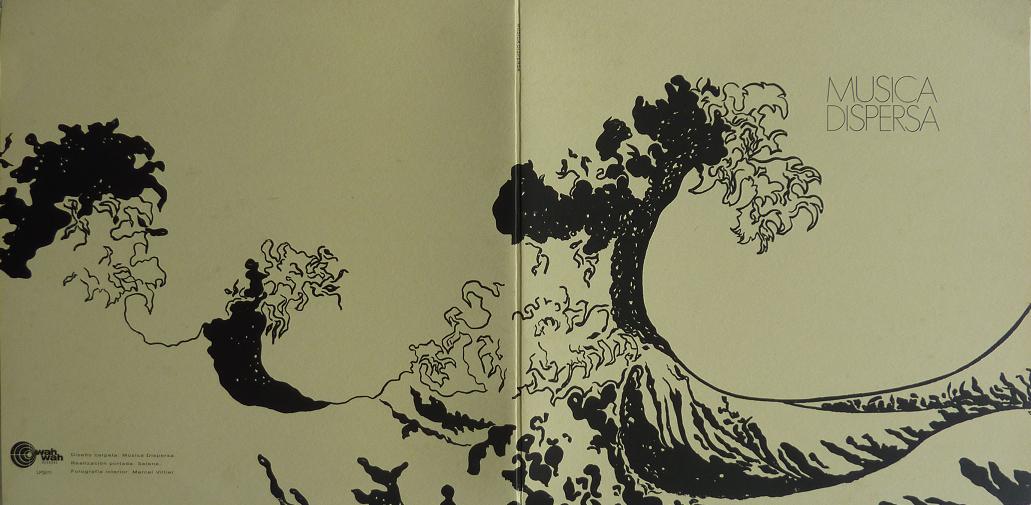
Loathe to miss the opportunity to broaden my musical horizons, I got Daniel to point me in the direction of some notable Spanish artists of the Franco era and he came up trumps. Following on neatly from my last blog entry, much of Boikot's stock consists of 180 gram vinyl reissues. I picked up a copy of Máquina!'s highly acclaimed debut LP, Why? from 1970 and Musica Dispersa's eponymous and sole album, also released in 1970, both beautifully reproduced by Wah Wah Records.
It seems that many of the bands of the era were intertwined, sharing members and accepting changing line-ups as part and parcel of contending with compulsory military service. Some came to view themselves as collectives rather than groups with a stable and fixed personnel. The impression I have is of a scene that was dynamic, constantly evolving, and that burned brightly but briefly. It is no exaggeration to suggest that artists such as Máquina! were as important to Spain's counter-culture as Bob Dylan was to that of the USA. Even the sleeve art to Why? was designed to provoke and rally opposition to Franco's regime. Apparently, Salvador Dali approved of the image of a pocket watch embedded in a croissant, a thinly disguised call for Spanish youth to realise that it was time to wake up to what was happening around them. The name Máquina! is itself confrontational, originating as it does from an expression whose meaning is perhaps too culturally specific to translate well, but was used by those doing miltary service. They would exclaim "Máquina! Dos cafés" (Machine! Two coffees), meaning something along the lines of "Fuck You".
Poster insert
Why? is the type of album that bands only produce before the spectre of self-awareness causes them to compromise their art. Once bands begin to analyze what they are doing, the music they produce is rarely a true representation of what is in their souls. Why? comes across as an unedited stream of consciousness, a disgorging of ideas that had been left unexpressed prior to the moment that they were committed to tape. This makes for a somewhat schizophrenic album, but one that is never less than captivating. The opening cut, I Believe, comes across like Dave Brubeck's Take Five with incisive fuzz guitar: mannered coffee house jazz on a Haight-Ashbury trip. The listener is left unprepared for the title track that follows and plays out over two sides of vinyl as the band sets the controls for the heart of the sun. It is a jam, a glorious release, a flood of ideas purged in one take. It begins with a pleading, almost bluesy vocal after which the track becomes progressively unhinged with fuzz, wah-wah and Hammond all vying for attention, scything around the elastic bass lines and the drums which flirt with jazz before launching into a full-on tripped-out Burundi assault. The final track, Let Me Be Born, regains a degree of sanity with a throbbing, suspenseful bass line, an urgent vocal, wah-wah guitar and flute to the fore, ending the LP with an element of psychedelic funkiness.
Musica Dispersa are aptly named as their music stubbornly refuses to be pigeonholed. Is it Acid-Folk, Progressive, Avant-Garde, Psychedelic World Music...? Well yes, all of the above and more.
The LP opens with snorting and nonsensical muttering, setting the tone for an album that utilises vocals as another instrument rather than as a vehicle for lyrics. In the absence, for the most part, of a traditional drum kit, the bass player provides the glue that binds the music together with some beautifully engaging rhythms. Various hand percussion, slaps and claps add rhythmic texture throughout.
Musica Dispersa
After just a handful of listens, one of the tracks that has made the biggest impression on me is Gilda, a dreamy, meandering, piano-led tune with a vibe not dissimilar to an even more chilled Planet Caravan. I bet that's the first time anyone's ever compared Musica Dispersa to Black Sabbath! Rabel sounds like something from a North African souk, whilst Cefalea, with its hypnotic rhythm, Cherokee chant and up-front Jew's harp twang, sounds like something the Beta Band soaked themselves in before hitting the recording studio. Arcano, the only track with a 'traditional' drum kit backing throughout, bounces along on a superb, almost dub-like bass line and features Hare Krishna-style chanting and snake-charmer flute. Listen to this bass groove and tell me that Damon Albarn and his Gorillaz didn't sit up and take notice of this LP.
One sure way to know if you have crossed the line from vinyl enthusiast to obsessive vinyl junkie is if you choose an original copy of an LP (despite it looking like Edward Scissorhands has been breakdancing on it) over a pristine later issue. For the 'serious' collector, early copies (preferably first pressings of course) are the only ones worthy of consideration. Owning a later re-issue is at best a compromise, at worst a shameful blot on a collection that has to be apologised for in conversations with others who share your particular brand of vinyl hoarding O.C.D. Either that or it has to be separated from the main collection, hidden away from mocking eyes like a grubby skin mag under a teenager's mattress. The chances are that you suffer from this strange urge to seek out first pressings if you own books like the one I've been poring over recently: Labelography - The Major U.K. Record Labels by Jan Pettersson.
What a rivetting read! This makes the guest publications used on the fill-in-the-missing-headlines round on Have I Got News For You (you know the kind of thing, The Alpaca Shearer's Gazette, The Crumpet Butterer's Chronicle) look as mainstream as The Daily Mail. My excuse is that I use it to ascertain the rarity of what I already own or stumble across in junk shops, not as a shopping list. Yes, it would be great if all my Vertigo albums had those trippy swirly labels, but the fact that some of my Black Sabbath LPs are on the spaceship Vertigo label or even (oh, the shame!) on NEMS doesn't keep me awake at night. Obviously, if I happen upon any Sabbath, Stones or Beatles first pressings in my local charity shop I'll be sure to find shelf space for them. Why else do you think I chose the pseudonym 'Shelf-Stacker'?
As someone who needs a tangible music collection, 'owning' MP3 files of various obscurities from the Sixties and Seventies holds no interest. I often justify my vinyl-buying habit by telling my wife that my collection is my pension, but of course, ultimately, I'd have to sell it for it to fulfil that particular purpose. Still, at least I have that option: good luck selling your MP3 collection, I hear there's a big demand for invisible, second-hand, ones and zeros! What I have come to realise is that while I'm waiting for that elusive original Decca pressing of Leaf Hound's Growers Of Mushroom to fall into my hands for a quid at the next Car Boot Sale, there are some really good 180 gram virgin-vinyl re-pressings available of LPs that realistically I might never see, let alone own in their original form. Let's face it, many original pressings are as hard to find as a Dodo's G-spot.
The packaging of these re-issues is often impressive, with beautifully reproduced artwork, informative sleeve notes and, in some cases, extra tracks, not on the original release. I generally have a bit of a problem with extra tracks though, whether on LP or CD, in much the same way that I can't be bothered with all the extras that invariably come with DVDs. Why on earth would I want to see all the rubbish that got dumped on the cutting room floor, deemed too dull, irrelevant or poorly realised to make the final cut of a film? Why would I want to have a rough-as-arseholes demo of a track that didn't make the grade on the original LP tagged onto the end of the re-release so that my enjoyment of the album is forever marred by its presence? I like to kid myself that magic happens when musicians are in the recording studio: a hard illusion to maintain if the listener is privy to the umpteenth amateurish, warts-and-all take prior to the producer packing the band off to the pub so that he can tart up their inept efforts with his studio trickery and banks of effects. Let's keep the wizard behind the curtain.
This Sunbeam Records re-issue of Czar's self-titled album from 1970 is typical of the label's output: faithfully reproduced artwork, a gatefold sleeve complete with an essay giving a modern perspective on the record's significance, heavyweight vinyl and a second disc containing all the extra tracks so that you needn't ever hear them if that is your preference.
Reputable companies like Sunbeam ensure that the artists actually get royalties for the sale of their music. For many years the only way to get hold of some of the more obscure psychedelic and progressive albums was to purchase suspect, non-legitimate re-issues on fly-by-night labels who clearly had no access to the original master tapes. I have LPs by Power Of Zeus (The Gospel According To Zeus) and The End (Introspection) which at first glance appear to be originals, but are in fact cleverly executed fakes. Even the labels on the records have been reproduced to give the illusion of originality, more successfully on the Power Of Zeus LP it has to be said.
There is no clue whatsoever on the sleeves or discs as to who produced these facsimile LPs, but facsimiles they are. Loathe to stump up the £100+ required to snag an original copy of Introspection, I'll settle for my dodgy doppelganger until I hit jumble sale paydirt. Especially as the sound quality is superb.
Put your feet up, pour yourself a herbal tea (or similar) and enjoy a selection of my favourite tracks from some of these re-issues. Hope they tickle your G-spot!
There seems to be a glut of bands from the USA and Canada featured on this blog with enviable facial hair. Outside the United States you have to look to the Middle East for comparably moustache-centric nations. Indeed, some of the skirmishes during the Gulf War must have resembled particularly bloody disagreements at a Freddie Mercury fan convention. Sure, the British did face fuzz back in the 1970s, but often in a restrained, university lecturer style: more a case of failing to shave than consciously and creatively fashioning a chin or lip coiffure. Of course, there were some notable exceptions: the awe-inspiring sideburns clinging to the fizzogs of Slade's Noddy Holder and Trevor Bolder in his Spiders From Mars days have few serious rivals and the magnificent Moody Blues have done much to champion the Victorian cad and bounder 'look'. Mike Pinder in particular looks as if he was born to wear a Royal Hussars jacket and make inappropriate comments to your sister about the turn of her ankle beneath her crinoline dress.
Bodice Rippers
I am delighted to have found a record in my collection by a band from the former East Germany whose cover seems to suggest that the lure of the lip duvet managed to penetrate the Iron Curtain.
Short-lived Zappa/Lynne Supergroup
Not only is one member of Puhdys sporting a Barnet and nose-doormat combination that surely infringes Jeff Lynne's copyright, but he is doing so back in 1979 when Jeff's white 'fro look was at its zenith. They had to buy their Levis on the black market and had no choice but to eat boiled cabbage and potatoes at every meal, but, somehow or other, the East Germans were hip to the styles being sported by all the cool English kids back in '79.
10 Wilde Jahre (10 Crazy Years) contains one superb track, Ikarus II, which sounds like Hank Marvin jamming with a Space-Prog Boogie band. The remainder of the LP is unadulterated rubbish having more than a whiff of the bierkeller about it. Despite the absence of a brass band, there is something a tad 'oompah' about the rest of the tracks, as if the musicians are unable to free themselves from the malignant influence of the traditional German music that seeped into their collective subconscious in their formative years. It's comparable to an English guy going to a rave and finding that despite his best efforts he can't dance without waving a handkerchief and jingling a set of ankle bells because he was exposed to morris men as a child. I'm sure there are men with heroic mullets, bum-fluff moustaches and stone-wash jeans who, when they're not listening to David Hasselhoff CDs, get off on this 'oompah' rock, but it does nothing for me. Ikarus II on the other hand...
Now that the fires have been put out and the big clean up has begun, the less immediately obvious effects of the riots that hit London last week are becoming apparent. Because a bunch of selfish dickheads couldn't do what the rest of us do when we want a new plasma television (that is, save up for one or do without), innocent people have lost their homes, their livelihoods and even, in some cases, their lives. How many of the morons who thought they were fighting capitalism by burning down the Sony warehouse in Enfield, North London, gave a moment's thought to the consequences of their actions? As it turns out, that warehouse contained the entire stock, both CDs and vinyl, of as many as one hundred independent record labels for whom Sony acts as distributor. There are rumours that many of these labels also used the warehouse to store their master tapes, so many recordings will be lost forever. Most of these independent labels are run on a shoestring and have no chance of surviving a catastrophe like this. Congratulations scumbags, in one fell swoop you've managed to kill off one hundred small, struggling businesses and left hundreds of bands without a label and without hope. Yeah, you really stuck it to the man! We know who to blame when there are no more independent labels left to release challenging, edgy, non-mainstream music. Let's face it, the ultra-cautious major labels aren't going to take a chance on anything that can't be stacked high and sold alongside the other landfill-bound tat in Tesco. Welcome to a world of nothing but lowest common denominator X-Factor dross. I ardently hope that the geniuses that torched the Sony warehouse are among those who have been kicked out of their council houses as a result of their crimes: good luck trying to find somewhere to plug in your stolen 52" plasma TV when you're living in a cardboard box.
A couple of weekends back Mrs Shelf-Stacker and I, accompanied by our very good friends Mr and Mrs Wurzel, attended the second annual High Voltage Festival in London's East End. And what a weekend!
...and the crowd went mild...!
It's always a relief not to be the oldest face in the crowd but, at the same time, it's great to see 'the kids' being well represented at an event like this. A healthy proportion of teens and twenty-somethings in attendance will help High Voltage to avoid becoming one of those cosy, nostalgia-fests that verges on necrophilia, with decrepit punters drooling over coffin-dodger bands. Having said that, I was determined not to let my dodgy knee get in the way of going crazy-ape-bonkers to bus pass-eligible headliners, Judas Priest. It's thirty years since I first saw them 'live' and they never disappoint. They're utterly ridiculous of course, but I don't want to stroke my chin, congratulate myself on my intellectual superiority and be preached to when I watch a band: I want to throw the devil's horns in the air, and sing really badly at the top of my voice. As Mrs Shelf-Stacker always says, she hates bands with a message, unless the message happens to be "Rock 'n' Roll All Night And Party Every Day". She is a woman of simple tastes.
How Metal?
So what's any of this got to do with vinyl then? Well, around the festival site were a number of stalls selling music: plenty of the devil's coasters of course, but a very healthy selection of vinyl LPs too. I'm not one to pass up the opportunity to add to my collection, but the thought of carrying a bunch of records around when I could have a pint of Hobgoblin in one hand and an organic courgette flower and pheasant wrap in the other just did not appeal. I was however delighted to see that many of the bands playing at the festival had their albums available to buy on vinyl alongside a not insignificant number of those very sexy 180 gram vinyl re-issues of obscure prog and proto-metal bands' efforts from the Sixties and Seventies. Even better, loads of people were flicking through the vinyl troughs. Better still, many of them were punters young enough to have bought their first ever album as a download. Best of all, they were actually purchasing the LPs, not just looking at them and trying to work out how the hell these weird looking CDs would ever fit in the little drawer on the side of their laptops. I did however find myself wondering how many of these LPs would be as warped as a Gary Glitter theme park by the end of, what was, a very warm weekend. I was particularly concerned for the LPs that were held aloft in the crowd as some sort of a show of loyalty or as an attention seeking device: look over here, I'm waving a brand new, sealed and quite possibly wavey-edged LP at you while you're up there rocking in the blazing sunshine. Can't you see what an Über-fan I am?
All is not necessarily lost for those over-exuberant festival punters' records. Today, with the thermometer pushing 30°C and with a number of warped LPs that I hope to restore to flatness, I have decided to conduct an experiment. To that end I have placed warped copies of The Hits Of Edwin Starr and Canadian band Sheriff's eponymous and only album between two panes of glass weighted down with bricks and left them in the sun for it to do its worst. I'm hoping that the heat of the sun will soften the vinyl which will then be sufficently malleable to be squeezed flat by the weight of the bricks on the glass. All I have to do is wait for the records to cool down when the sun sets and, Bob's your uncle! Well, that's the theory.
What did you do today, darling?
Incidentally, the Thomas The Tank Engine sandpit on which the whole shebang is resting is probably not essential to a successful outcome, so don't worry if you don't have one. I'll let you know how things turn out.